what type of grass seeds to use for science experiment
Botany Projects
In Which Liquids Do Seeds Grow Best?
Unremarkably, when nosotros think about planting seeds, nosotros remember of planting them in the earth, or in soil that'south been put into containers. A healthy seed placed into soil and given the proper amounts of water, calorie-free, and heat will sprout, or germinate, and grow into a plant.
But did you know that seeds besides can be germinated in liquid? Information technology'due south truthful. In fact, many plants tin can be grown into maturity without any soil at all. Growing plants in water instead of soil is called hydroponics, and information technology's a fascinating type of horticulture. Horticulture, as y'all might know, is simply the science of cultivating plants. Some people refer to horticulture as an fine art, particularly when information technology pertains to decorative plants.
For this science project, notwithstanding, we're interested in seeing which liquids are best for sprouting seeds. You lot won't be using hydroponics to grow plants to maturity, merely that's something you might want to explore on your own.
Permit's get started now and find out which liquids seeds grow all-time in.
And so What Seems to Be the Problem?
The problem, or question that y'all'll respond in the form of this projection, is ?In Which Liquid Practise Seeds Grow Best?? Following conspicuously defined steps and procedures, yous'll solve the trouble during the course of your experiment.
Past the time you've finished your experiment, you lot'll know what type of liquid the seeds you've planted similar the all-time?and the worst. Some seeds may grow quickly, and others may not abound at all. You will have answered whether seeds prefer milk, iced tea, vinegar, orange juice, club soda, or manifestly one-time tap water.
Bones Elements
Hydroponics is a fancy-sounding discussion, just it's nothing more than the do of growing plants in a h2o solution to which nutrients have been added. The difference from the regular method of growing plants, of course, is that no soil is used.
The problem y'all've stated happens to too exist the suggested title of your scientific discipline off-white project. While your trouble must always be a question that you're attempting to answer, your science fair title does non necessarily have to be in question form. You also could use one of the following names as the title for this project:
- What'south the All-time Liquid for Germinating Seeds?
- Testing Variables When Sprouting Seeds
Once you've identified and stated your problem, yous should accept a few minutes to retrieve about the point, or purpose of your projection.
What's the Point?
So why should you, or anybody else for that thing, give the slightest idea to sprouting seeds in dissimilar liquids? What'due south the point?
Until at present, you lot've probably causeless that seeds sprout ameliorate in water than in any other liquids. Correct? Well, maybe they do. In this project, h2o is the control, or the substance with which we'll exist comparison all the other liquids. The other liquids are the variables.
Standard Procedure
If y'all're interested in learning more than most hydroponics, cheque out a website called The Growing Edge. It's at world wide web.growingedge.com/kids.
Merely, unless you've already experimented to find out, you can't be certain that water is the best liquid for sprouting seeds, can yous? How do you know that a seed placed in orange juice won't grow into a beanstalk to rival the one Jack climbed in that famous fairy tale?
The point of this project is to apply the scientific method to solve the problem stated above and detect out in which liquids seeds grow the all-time.
What Practice You Think Will Happen?
Before you country your hypothesis (see Understanding and Using the Scientific Method for more on the hypothesis), have a few minutes to think virtually the liquids in which you'll be trying to sprout bean seeds. Nosotros chose bean seeds considering they're adequately large and piece of cake to piece of work with, and they sprout quickly, usually in about a week.
Explosion Ahead
Never, never, never put anything in your mouth or on your skin unless you're absolutely, one hundred percent sure that information technology won't injure you lot. None of the materials used in this project will crusade you any impairment, but y'all may want to utilize circumspection if you're going to odour or sense of taste vinegar?it can burn if it gets in your eyes.
Once more, the liquids you'll be using are:
- Milk
- Iced tea
- Vinegar
- Orange juice
- Club soda
- Water
You lot've probably seen, smelled, and tasted nearly all of these substances. If non, y'all might desire to do and then before you lot come up with your hypothesis.
Once you've examined the liquids you'll be using, try to think of some ways in which they might touch on the seeds. Are some of the liquids more nourishing than others? Exercise you think whatever of them might really harm the seeds? In one case you lot've given the affair some thought, y'all can brand and record your hypothesis.
Materials You'll Demand for This Project
Everything you need for this projection should be easy to find. In fact, you probably already have most of the materials in your house. If your scientific discipline fair is in the middle of winter and you live in a cold climate, y'all might have a piffling problem finding edible bean seeds in a shop virtually your home. Everything else, however, should be readily available. You need:
Standard Process
If you lot can't notice bean seeds in a shop virtually your home, in that location are lots of Net sites from which you can purchase them. Ane of those sites is the Garden Store Online, found at gardenshoponline.com. A pack of edible bean seeds will toll you about $2.fifty.
- 8 ounces (240 ml) each of tap h2o, milk, iced tea, vinegar (either white or cider), orange juice, and order soda
- One package of bean seeds
- Six (10- or 12-ounce) (300 to 350 ml) drinking glass or plastic cups, notwithstanding color and size
- Permanent marker
- Tray or shallow pan
- Metric ruler
- Paper towels
Be sure that you've cleared a space and take everything you'll need for your experiment before you get ready to kickoff. And e'er be certain to check with a parent earlier you use household items such as glasses or markers.
Conducting Your Experiment
Standard Procedure
Remember that there are unlike indicators that will help you lot effigy out which liquid the seeds like best. At this point of the experiment you're looking to come across how many seeds in ane drinking glass sprout, and which seeds sprout the most apace. Those are ii indicators that will help you determine your results.
One time you've completed the early steps of the scientific method every bit explained in Agreement and Using the Scientific Method, you lot'll exist ready to start your experiment.
Remember to work advisedly and in a logical manner. Endeavor not to knock over any of the glasses, and be certain that you write the correct names of the liquids on the spectacles. Water, club soda, and white vinegar all await pretty much the same, but they may accept very dissimilar effects on bean seeds.
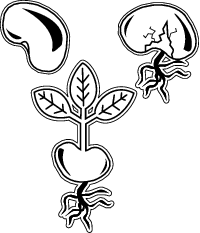
The stages of seed germination.
- Using the permanent marker, label each of the 6 cups with the proper noun of the liquid it will comprise.
- Place the cups on the tray or shallow pan.
- Pour 8 fluid ounces (240 ml) of h2o (your command liquid) into the cup labeled h2o.
- Cascade 8 fluid ounces (240 ml) of each of the other liquids into its proper loving cup.
- Open the parcel of seeds and split up them evenly into half dozen piles. Yous might have a few seeds left over that you won't utilize.
- Slowly add the seeds from the starting time pile into the cup labeled water.
- Continue putting the other piles of seeds into each of the v remaining cups.
- Place the tray with the cups where you tin easily observe the seeds. You'll want to proceed the temperature as constant as possible, so make certain the seeds are in an surface area where there are no drafts. And, make sure the seeds won't get bumped or knocked over.
- Go along a daily record of your observations. To do so, write downwardly how many seeds are in each cup, and how many seeds break their shells and begin growing, or germinating, every day. Use the first nautical chart shown in the adjacent section, ?Keeping Track of Your Experiment,? to help you lot to record your observations.
- A week afterwards you placed the seeds in the diverse liquids, measure out each sprout in centimeters. If your seeds haven't sprouted yet, sit tight and begin measuring them at two weeks. You'll need to tape the length (in centimeters) of each sprout in every loving cup. Y'all can make information technology easier to measure the sprouts by removing each 1, placing it on a paper towel, and measuring its length with a metric ruler. Once you've measured every sprout, you'll need to figure out the average length of the sprouts in each liquid.
Standard Procedure
Be sure to mensurate all the seedlings from one cup and replace them into their proper cup before starting to measure those that were sprouted in a different liquid. Information technology'due south absolutely necessary that yous continue the sprouts in their proper cups.
Apply the 2d nautical chart found in the next section to record the average length of sprouts in each cup after one or two weeks of growth. The average length of the sprouts in each loving cup is another indicator of which liquid the bean seeds like the about.
Follow these steps to calculate the average length of all the sprouts in each of the liquids:
- Add the lengths of all the sprouts from one cup. If you had iv beans in one cup and each of the sprouts was ane/two-inch long, for instance, your total would be ii inches.
- Split the total length by the number of sprouts you measured.
- The average length equals the total length divided by the number of sprouts measured.
Keeping Rail of Your Experiment
In one case you've observed and recorded everything that occurred during the grade of your experiment, it'due south time to present this information conspicuously.

Employ this nautical chart to tape your daily observations of the seeds.

Use this chart to record the length of each sprout, in centimeters.
To practice this, you'll need to present all of the measurements you've taken. These measurements should include the following:
- The number of seeds you placed in each liquid
- The number of seeds in each liquid that began germinating on a daily ground
- The average length of seedlings in each liquid later a one- or two-week period
All of these measurements should be neatly presented on the post-obit charts. The number of seeds placed in each liquid and the number of seeds that germinated in each liquid should exist recorded on the kickoff chart. The boilerplate length of the seedlings should be recorded on the second chart.
Putting It All Together
One time you've analyzed your data, you'll exist able to summarize what you've learned, and you'll see whether your hypothesis was right. You volition have reached a conclusion, which is the terminal step of the scientific method. You will have answered the question posed in your trouble, and know if you were right in making your hypothesis.
Call back that if your hypothesis turned out to exist incorrect, it doesn't mean that your experiment was a failure. It just means that the results you got were not the ones y'all thought you would.
The experiment part of your projection has concluded.
Further Investigation
Standard Procedure
Nearly every scientific experiment tin be adapted or modified in gild to solve a similar, but not entirely the same, trouble. Don't be afraid to use your scientific curiosity and think of other questions for which you want to notice answers.
If y'all enjoyed doing this project and would like to take information technology a footstep or two farther, consider what would happen if you grew the seeds in regular potting soil, but watered them with the different liquids you used for this experiment.
Maybe something in the potting soil would react favorably with orange juice, for instance, and cause the beans to shoot upward in record fourth dimension. Peradventure if you watered the seeds with Hawaiian Punch, your bean plants would produce red beans.
If you're interested in investigating this idea, just adapt the steps yous used when sprouting beans in the liquids. And have fun!
Excerpted from The Complete Idiot'south Guide to Science Fair Projects 2003 by Nancy 1000. O'Leary and Susan Shelly. All rights reserved including the right of reproduction in whole or in part in whatsoever form. Used by arrangement with Blastoff Books, a member of Penguin Group (USA) Inc.
To order this volume direct from the publisher, visit the Penguin United states website or phone call 1-800-253-6476. You can also purchase this book at Amazon.com and Barnes & Noble.
Source: https://www.infoplease.com/homework-help/math-science/science-projects-beginners-botany-projects
0 Response to "what type of grass seeds to use for science experiment"
Postar um comentário